
Free Letter of the Week Curriculum: Letter R Worksheets & 3-Day Lesson Plan.

Updated: Jul 7
📌 Quick Navigation Links:

Letter R Worksheets & 3-Day Lesson Plan
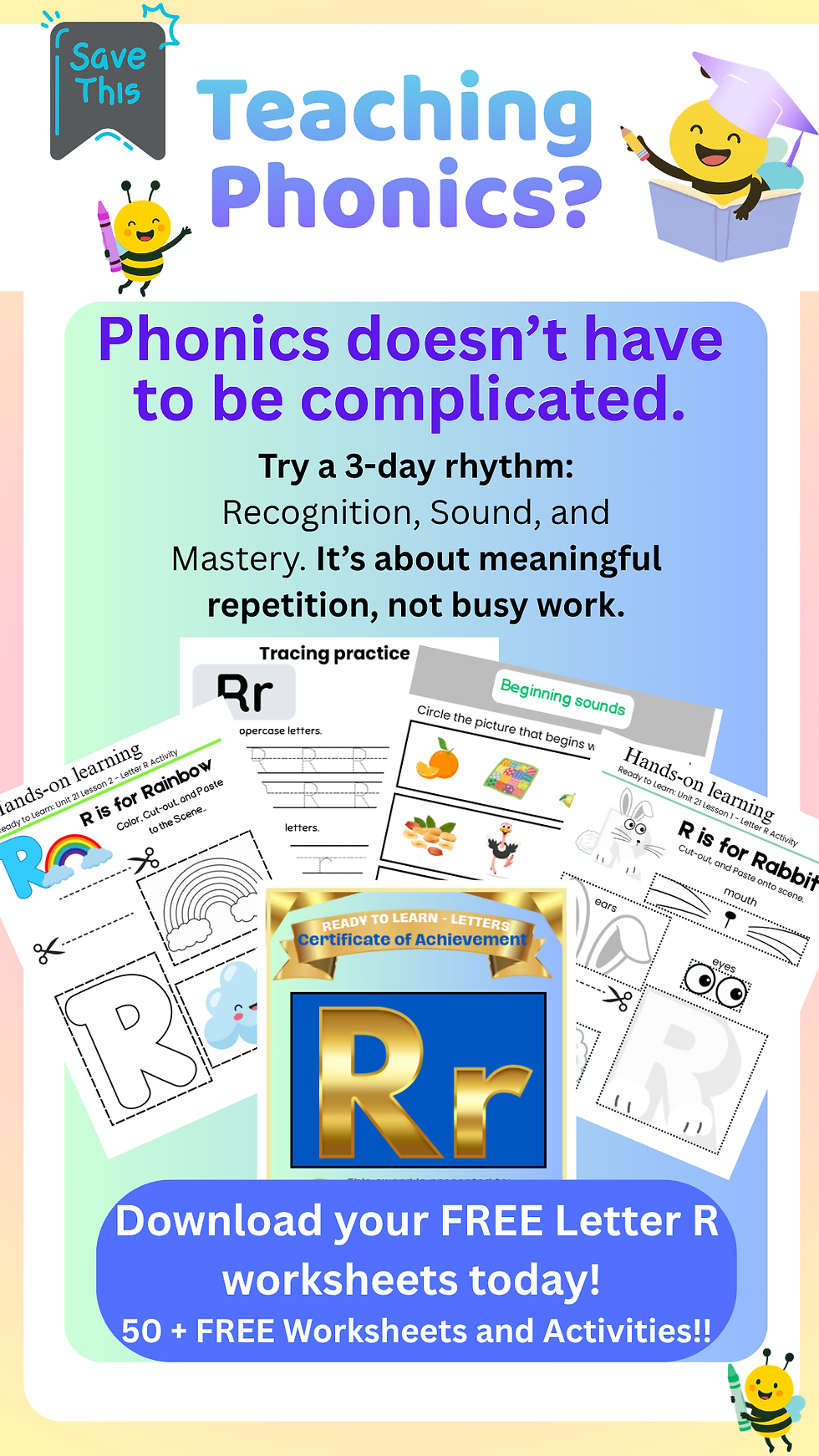
Looking for a simple and joyful way to teach the letter R? This free Letter R Worksheets & 3-Day Lesson Plan is part of the Ready-to-Learn Letters curriculum from Learning Made
Easy. It includes letter recognition, beginning sound practice, handwriting, worksheets, activities, games, a letter song, and an alphabet character story.
In this week's lesson, children will meet Rosie the Robin, practice the /r/ sound, and build early reading confidence with hands-on activities designed for preschool, kindergarten, and homeschool families.
Whether you are teaching letter of the week, building reading readiness, or looking for free kindergarten homeschool phonics lessons, this Letter R bundle gives you a ready-to-use path for teaching one letter at a time.

Building a Strong Foundation with Science of
Reading
Early literacy methods are the building blocks of a child's reading journey. Think of them as the sturdy foundation that supports everything else. When children develop strong early literacy skills, they're more confident and ready to tackle the exciting world of words. Fluent letter and sound recognition is a key indicator of future reading success.
Why Letter Recognition is the Key to Phonics Success
Letter–sound knowledge is one of the strongest predictors of later reading success
Multiple studies and reviews show that children who quickly and accurately connect letters to sounds become stronger decoders and readers overall. Research from the Texas A&M Institute for Early Childhood Development explains that key early literacy skills reliably predict future reading success, including letter and letter-sound knowledge (Communications, 2025).
This predictive power is so strong that early assessments of letter–sound fluency are often used to identify students at risk for reading difficulties.
Phonics depends on mapping sounds to letters.
Phonics instruction teaches children how written letters represent spoken sounds. Without fluent access to those letter–sound correspondences, children cannot apply phonics efficiently.
The National Center on Improving Literacy details how the connection between letters and the sounds they represent is where phonics "begins." (National Center on Improving Literacy, 2026).
If a child must pause to recall what sound a letter makes, cognitive load increases and decoding breaks down. Reading requires multiple processes happening at once: recognizing letters, retrieving sounds, blending, and monitoring meaning. When letter and sound retrieval is automatic, children can devote their attention to blending and comprehension.
Fluent letter-sound knowledge is the essential building block for successful phonics instruction and reading development, enabling children to decode efficiently and comprehend effectively.
"Our 8-step roadmap guides your child from their first letter sounds to independent reading mastery."

A Proven Kindergarten Homeschool Reading Path
At Learning Made Easy, we follow a proven 8-step phonics program designed to help children progress from their first letter sounds to confident, independent reading.
The Ready-to-Learn Letters series serves as the Step 1 Foundational Pillar of this journey. Before a child can blend or decode, they must have a rock-solid grasp of letter recognition and sound awareness. By mastering this first pillar, your child builds the stability needed for the next seven steps of our phonics-first curriculum.
Step 1 isn't "just the alphabet." It's the start of reading confidence!
Your student should be able to recognize all letters of the alphabet and all initial letter sounds before moving on to our next stage: the Reading Made Easy program. This upcoming series builds on the skills learned here. The next levels transition children from recognizing letters to confidently reading their first books.
Reading Made Easy Levels 1 & 2 are designed to follow naturally after the Ready-to-Learn Letters Program. They guide children from letter mastery to reading and decoding more complex words and stories.
Typically, mastery does not come from a single worksheet or even a few. For many children, it comes from repetition, familiarity, and confidence-building practice over time.
That is why our kindergarten homeschool program includes a large number of worksheets focused on the same core foundational skills:
Letter recognition
Uppercase and lowercase identification
Beginning sounds
Letter tracing and writing
These worksheets are not busywork. They are intentionally designed to:
Reinforce the same skill in multiple ways
Reduce cognitive overload
Allow children to practice without pressure
Support mastery before progression
The Passion That Drives Simplified Learning

The Ready-to-Letters Program from Learning Made Easy exists because early readers deserve strong foundations, and families deserve support without pressure.
This program was created by a parent who once needed every free resource I could find. It is built on the belief that reading confidence grows through mastery, not memorization, and that learning should meet children where they are.
When learning is made easy, confidence follows. And when children can read, everything else becomes possible.
Ready to start your journey? If you're looking for a structured yet joyful way to teach, explore Ready-to-Learn Letters and see how it can make early literacy fun and effective for your homeschool.
Ready-to-Learn Letters features 31 units and 83 lessons filled with character-based stories, songs, and 1,000+ free worksheets. Ready-to-Learn Letters is designed to make your kindergarten homeschool experience easy, effective, and full of smiles!
Letter R Lesson for Preschool and Kindergarten
The Letter R unit focuses on helping children recognize uppercase and lowercase Rr, hear the beginning /r/ sound, and connect the letter R to familiar words like:
Rosie
robin
rainbow
rain
red
run
rise
road
rabbit
Young learners need repeated exposure to letters and sounds before those skills become automatic. That is why this lesson includes multiple ways to practice: songs, stories, tracing, coloring, cut-and-paste activities, games, flashcards, and review worksheets.
The goal is not to rush. The goal is to help your child recognize the letter R, hear the /r/ sound, and feel successful as they learn.
Meet Rosie the Robin
This week's alphabet character is Rosie the Robin.
Rosie loves to rise up and sing. She reaches for rainbows and all the joy they bring. But when rain clouds cover the sky and her outdoor concert is ruined, Rosie has to decide what to do.
At first, she feels sad. She wants to give up. But then Rosie remembers that she can keep going, even when things are hard.
While the rain falls outside, Rosie stays in her birdhouse and practices her song again and again. Then, when the rain finally stops, a beautiful rainbow stretches across the sky. Rosie flies outside and sings her song under the rainbow while all of her friends gather to listen.
This story gently teaches children about perseverance, courage, and not giving up when plans change.
Letter R Story Discussion Questions
After watching or reading Meet Rosie, talk with your child about the story. Here are a few simple discussion prompts:
How did Rosie feel when the rain started?
Why did Rosie want to give up?
What did Rosie do instead of giving up?
How did practicing help Rosie sing her song better?
What happened after the rain stopped?
Can you think of a time when something was hard, but you kept trying?
These questions help children connect the story to real-life character development while reinforcing listening comprehension and oral language skills.
Letter R Song
The Letter R song helps children practice the beginning /r/ sound in a fun, memorable way.
Children will hear words like Rosie, robin, rain, rainbow, red, run, and rise as they sing along and connect the letter R to its sound.
Songs are a wonderful way to support early literacy because children can hear the sound repeatedly in a playful way. The rhythm, repetition, and movement help make the lesson stick.
Letter R Sounds Video
The Letter R sounds video gives children more practice hearing and identifying the /r/ sound at the beginning of words.
In this lesson, children will practice listening for the sound in words like rainbow, robin, rabbit, red, rock, run, road, and rain. And as a special bonus, children will learn the 7 colors of the rainbow in order using ROY G. BIV — a fun mnemonic that connects phonics, art, and science all in one activity!
This is an important early phonics skill. Before children can read and spell words, they need to hear sounds clearly and connect those sounds to letters.
Letter R Worksheets and Activities
This free Letter R lesson includes worksheets and activities designed to build reading readiness step by step.
Children will practice:
Letter R recognition
Uppercase and lowercase Rr
Beginning /r/ sound
Tracing the letter R
Writing the letter R
Coloring the letter R
Cut-and-paste letter activities
Finding the letter R
Color by letter
Review and concept practice
These activities are simple, structured, and easy to use at home or in the classroom.
3-Day Letter R Lesson Plan
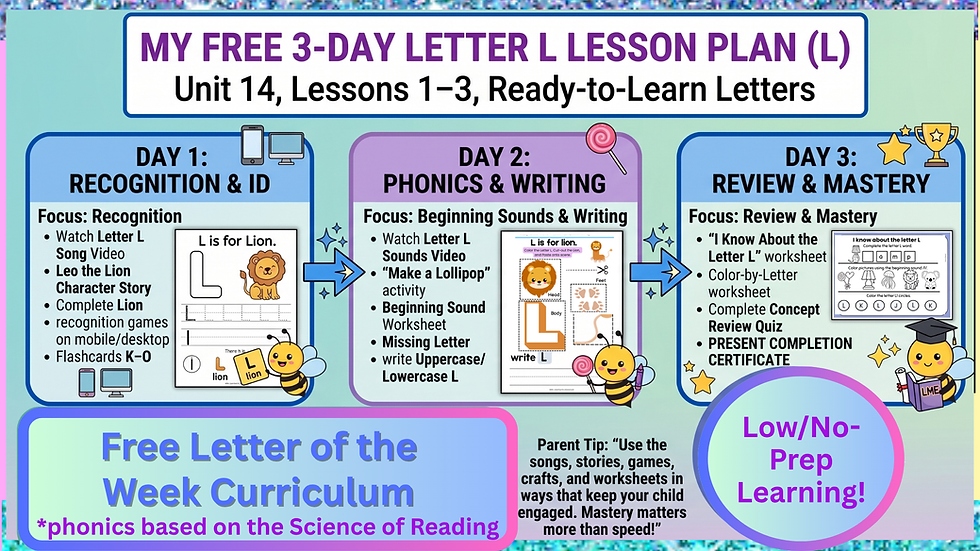
Building a consistent rhythm is the key to a successful kindergarten homeschool experience. This Letter R unit is organized into three simple lessons. You can complete the lessons over three days, or spread them out over a full week depending on your child's pace.
Quick note: Parents and teachers, please feel free to break this schedule up as often as you like to keep your child engaged. We've naturally provided a rhythm that jumps from music to crafts, writing, stories, reinforcement and practice, to games, and review. You ARE NOT required to complete each worksheet, but they are available as needed. Work with each letter until your child is ready to move on. Every 5 letters, we offer a review section for students to test their skills. If they need more practice, we have plenty more resources available to help.
Day 1: Letter R Recognition
Start with the Letter R song and introduce your child to uppercase and lowercase Rr. Then complete the coloring pages, read or watch Meet Rosie, and talk about the lesson in the story.
Day 1 focuses on helping children recognize the letter R and begin connecting it to Rosie the Robin.
Suggested activities:
Listen to the Letter R Song
Color the letter R
Watch or read Meet Rosie
Complete the Letter R cut-and-paste activity
Play Letter R recognition games
Review flashcards
Trace the letter R
Day 2: Letter R Beginning Sound
Day 2 focuses on hearing the beginning /r/ sound. Watch the Letter R sounds video and talk about words that begin with R. Say the words slowly and emphasize the beginning sound: /r/ /r/ rainbow /r/ /r/ robin /r/ /r/ red /r/ /r/ rain
Suggested activities:
Day 3: Letter R Practice and Review
Day 3 gives children more practice with the skills they have learned. This is the day to review letter recognition, handwriting, beginning sounds, and letter matching. Children can also complete the Letter R quiz and earn their Letter R completion certificate!
Suggested activities:
Simple Letter R Words for Kids
Here are some child-friendly Letter R words to practice throughout the week:
Rosie
robin
rain
rainbow
red
run
rise
rabbit
You can use these words during read-aloud time, handwriting practice, phonics games, or simple conversations throughout the day.
Try saying:
"Can you find something that starts with /r/?"
"Do you hear /r/ at the beginning of rainbow?"
"What letter makes the /r/ sound?"
Little conversations like this help reinforce the lesson naturally.
Free Letter R Games
The Ready-to-Learn Letters curriculum also includes free online games to help children practice letter recognition and beginning sounds.
Games give children another way to interact with the letter R while building confidence. Children can practice finding the letter, matching sounds, and reviewing what they have learned in a playful way.
Play Letter R Games:
Download the Free Letter R Worksheet Bundle
This Letter R bundle is designed to make teaching easier for parents, homeschool families, and teachers. You can use the worksheets as part of a letter-of-the-week plan, morning work, homeschool reading readiness, preschool phonics, kindergarten phonics, or extra practice.
We believe that quality education should be accessible to everyone. That is why our free letter-of-the-week curriculum includes comprehensive bundles like the one below to ensure your child has everything they need for mastery.
Download the Free Letter R Worksheets: [Add Download Link Here]
Short on time? Join our community, and I'll send the entire A–E Mega Bundle (all 5 units!) straight to your inbox in one neat PDF. No more individual downloading.
Teaching Tips for Parents
As your child works through the Letter R lesson, keep it light and encouraging.
Some children will recognize the letter quickly. Others will need more repetition. That is completely normal.
Keep pointing out the letter R in books, signs, toys, and everyday life. Say the /r/ sound together. Look for rainbows after the next rainstorm, find red objects around the house, notice roads, rocks, and rabbits. You can even practice ROY G. BIV at dinner with colorful fruits and veggies: red strawberries, orange carrots, yellow corn, green beans, and blueberries!
Make the sound part of real life. Reading readiness grows one small step at a time.
You're doing a great job.
Ready to move on to Letter S?
You can find the full curriculum, including 31 units and over 1,000 free worksheets, on the Ready-to-Learn Letters Hub.
Explore more FREE Lessons:
Want to skip the printing? Visit our store and explore offline workbooks and skill builders.
"I'd love to hear from you! What is your child's favorite 'R' word or activity from this week? Did they spot a real rainbow, race around the yard, or proudly color their ROY G. BIV rainbow? Share your favorite homeschool moments in the comments below. Let's support each other in making learning easy and joyful!"
Happy Homeschooling!


"Hi, I'm Maria Christine! As a homeschool parent, I know that building a strong reading foundation should be joyful, not overwhelming. I created Learning Made Easy to provide families with the simple, effective tools they need to help their little learners thrive."
📌 Frequently Asked Questions (FAQs)
What is the "Science of Reading"?
"The Science of Reading is a vast body of research from the last 50 years that explains how the human brain learns to read. It emphasizes that reading is not a natural process like speaking; it must be taught through explicit and systematic instruction in phonics, phonemic awareness, vocabulary, fluency, and comprehension. Our curriculum uses these evidence-based methods to ensure every child has the tools to become a confident reader."
What is the "Letter of the Week" strategy?
The letter-of-the-week approach allows children to focus deeply on one letter at a time, exploring its sound, shape, and related vocabulary. This prevents overwhelm and helps build a solid foundation for decoding and phonics.
At what age should I start early literacy strategies?
Most kindergarten homeschool rhythms begin around ages 4–6. However, you can start "pre-literacy" habits, such as reading aloud and playing with sounds, as early as toddlerhood to build phonological awareness.
How do multisensory tools help with letter knowledge?
Multisensory tools like playdough, sand, and alphabet games engage a child's sense of touch and movement. This helps "lock in" letter shapes and sounds more effectively than passive worksheets alone.
Are these Letter R worksheets really free?
Yes! You can download the full Unit 21 Letter R Bundle directly from this post. For those who want more, the complete Ready-to-Learn Letters Hub contains over 1,000 additional resources.
What is the difference between the free worksheets and the printed workbooks?
The free worksheets offer immediate, flexible access to core skills. The printed workbooks are curated collections that offer visual consistency, extended reviews, and assessments in a ready-to-use format — no printing required!
My child is struggling with a specific letter. Should I move on?
No. Our program is mastery-based, meaning it is developmentally normal for children to need repetition. We encourage you to use our extra worksheets and games to stay on a letter until your child feels confident.
How do I know when my child is ready for the next letter?
"Your child is ready to move on when they can consistently identify the letter's shape and its primary sound without hesitation. If they are still pausing to think, use our extra 'Skill Builder' worksheets and games for a few more days to lock in that mastery!"
What is ROY G. BIV?
ROY G. BIV is a fun mnemonic name that helps children remember the 7 colors of the rainbow in order: Red, Orange, Yellow, Green, Blue, Indigo, and Violet. In our Letter R Sounds video, children learn ROY G. BIV while coloring their rainbow craft stripe by stripe — connecting phonics, art, and science all in one activity!
References
Communications, C. (2025, October 7). Teaching Letters and Letter-Sound Knowledge. Education and Human Development. https://education.tamu.edu/teaching-letters-and-letter-sound-knowledge/
National Center on Improving Literacy. (2026, January 13). Phonics: What is it and why is it important? – National Center on Improving Literacy. https://www.improvingliteracy.org/resource/phonics-what-is-it-and-why-is-it-important

Comments